SaaS Factory · 9 min read
I have spent nearly thirty years building SaaS businesses. Over the years you get moments when your eyes light up when a new break through, feature or technology comes online. SaaS Factory is giving me more of these moments every week, and these are 10, there first use stories, and why they matter.
 By Glyn Trott, — SaaS Factory CEO
URL in, full market analysis out. A potential build dossier of Adjacent and Downstream Market Products, each with proof of pain, competitor pricing and some revenue maths. It also identifies the features your core product has, and what is missing. Run it on yourself, or on your competitors. I ran it on functionpoint.com, a sister Volaris business, and asked their leaders for brutally honest feedback.
Talia Palermo, product lead: “It clearly made quick work of what were previously some long winding paths for us… it did feel very close to the customers’ real needs.”
TJ Carlson, business leader: “Have you ever thought about this as a competitive analysis tool? Or some way to kill competitors?”
Why it matters. Hunches chased on gut feel can die expensively. This makes it a data led decision before a line of code exists, and with the Build it button, a fully evidenced product is one click away.
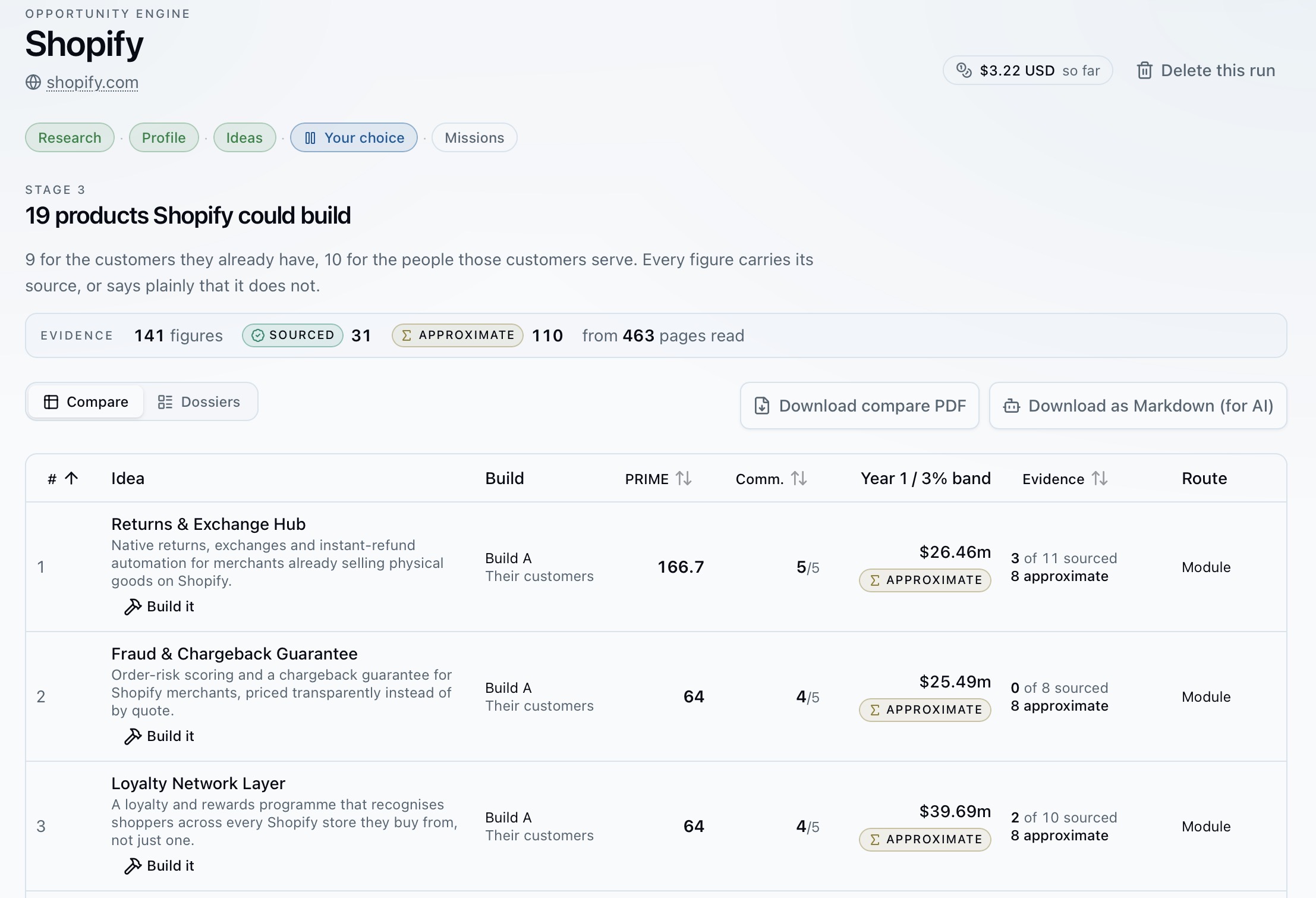
Download report: run on shopify.com.
Mission statement in, product out. The SF PO (Product Owner) Agent writes the spec, picks the tech stack, sequences the build, and keeps developing your product against the mission from day one. Once live, you set the PO’s mode: dominate your vertical, maintain, or off for manual control.
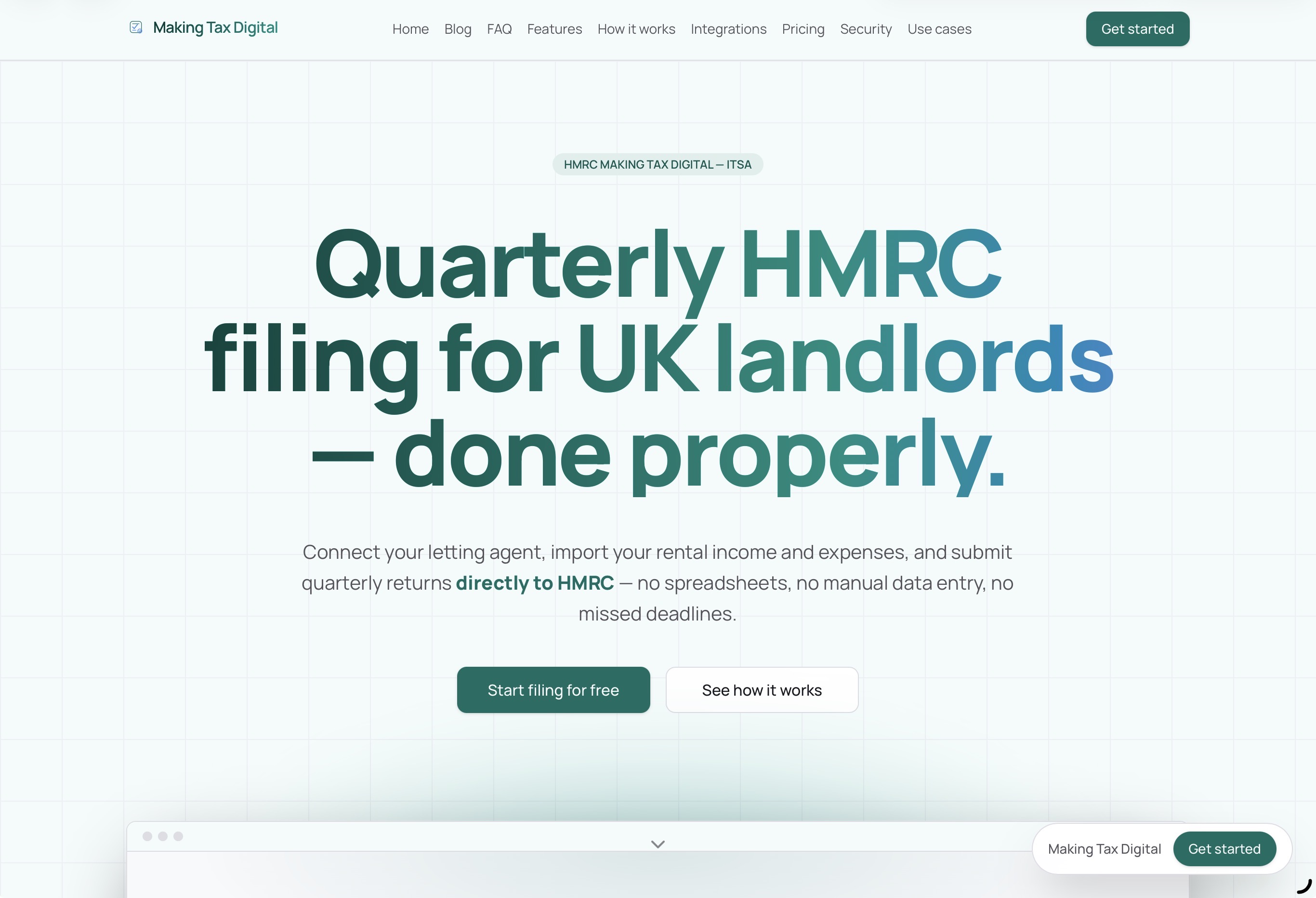
“I gave it one paragraph, 78 words: Making Tax Digital compliance for UK landlords. It worked out the hard parts itself, the HMRC OAuth connection, open banking feeds, the API connection to agentOS.com. Version 1 in a day, 90% there. I’m a non developer, and I’m also the app’s customer, a landlord who needs it. It blew my mind that I was staring at an MVP. I started a list of dozens more app builds in different verticals that day. Adjacent, downstream, internal ERP replacements, rip and duplicate plays.”
Why it matters. The gap between idea and product used to be a dev team, a budget and months. Now it is one paragraph and for a creative founder or product owner, speed to opportunity is boundless.
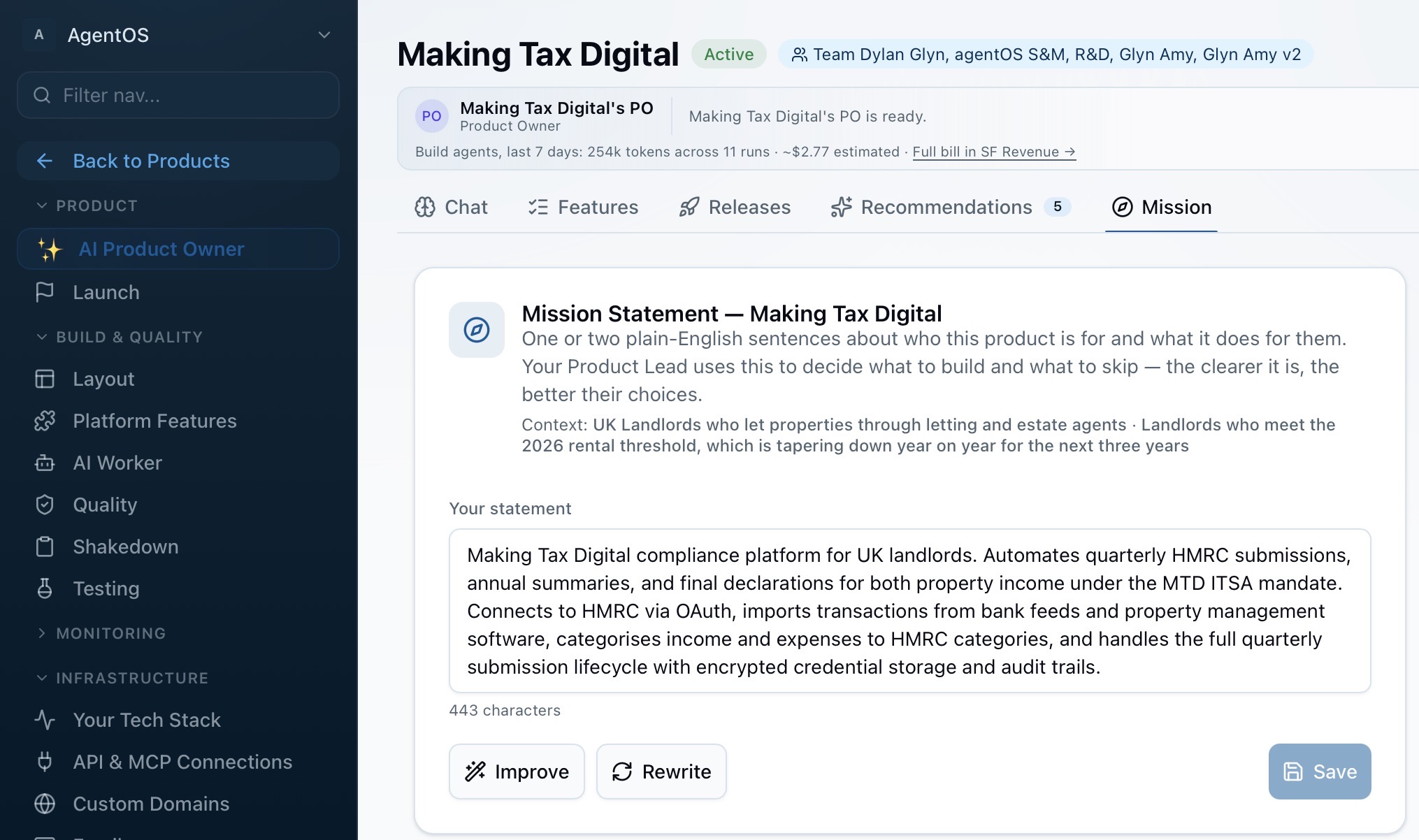
MTD mission statement (78 words) in, landlord-mtd.co.uk out.
Auth, database, emails, website, batch engines, payments. All set up behind the scenes while your product is being built, on tech that is enterprise scalable. The boring stuff every company needs.
“I built an app for Posibl.com, my CrossFit box’s brand. A stack with nothing to do with my day job. All the stuff I would have asked an external IT team to do and wait weeks, done and just there. No friction, no self learning, nothing to configure. That’s when it hit me, this is not a vibe coding tool. It’s a Vibe Building SaaS Company Platform, and it’s not just the tech stack, it’s the business stack with payments, websites, CRM, CSM, validation, moats.”
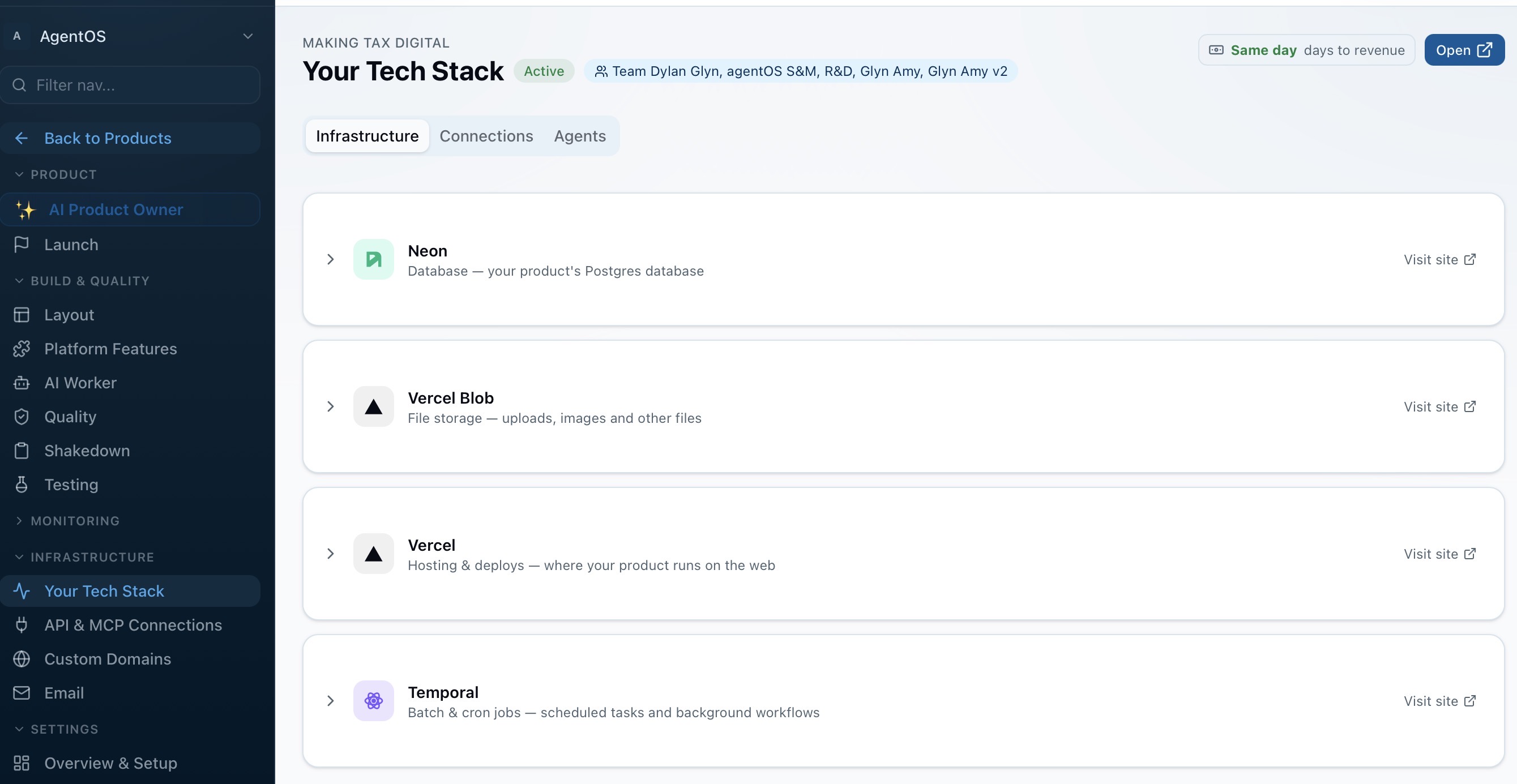
Why it matters. Every technical friction raises the chance you give up. As frictions stack, good ideas can quietly be given up on and die. Here the frictions never reach you, they are solved silently while you build.
Every SF product ships with a feedback widget. The SF PO Agent checks each request against the mission statement. If it fits, it builds, ships, and emails the customer that their request is live.
“SF was in autonomous mode, no human touching it. I was in the Making Tax Digital app as a landlord and asked for a profit figure on my dashboard and a capital gains vault to store paperwork for future tax savings. I carried on and about 30 minutes later, both features were just there. I had to do a genuine double take. Then the email arrived confirming my feedback had shipped. I was blown away as a customer.”
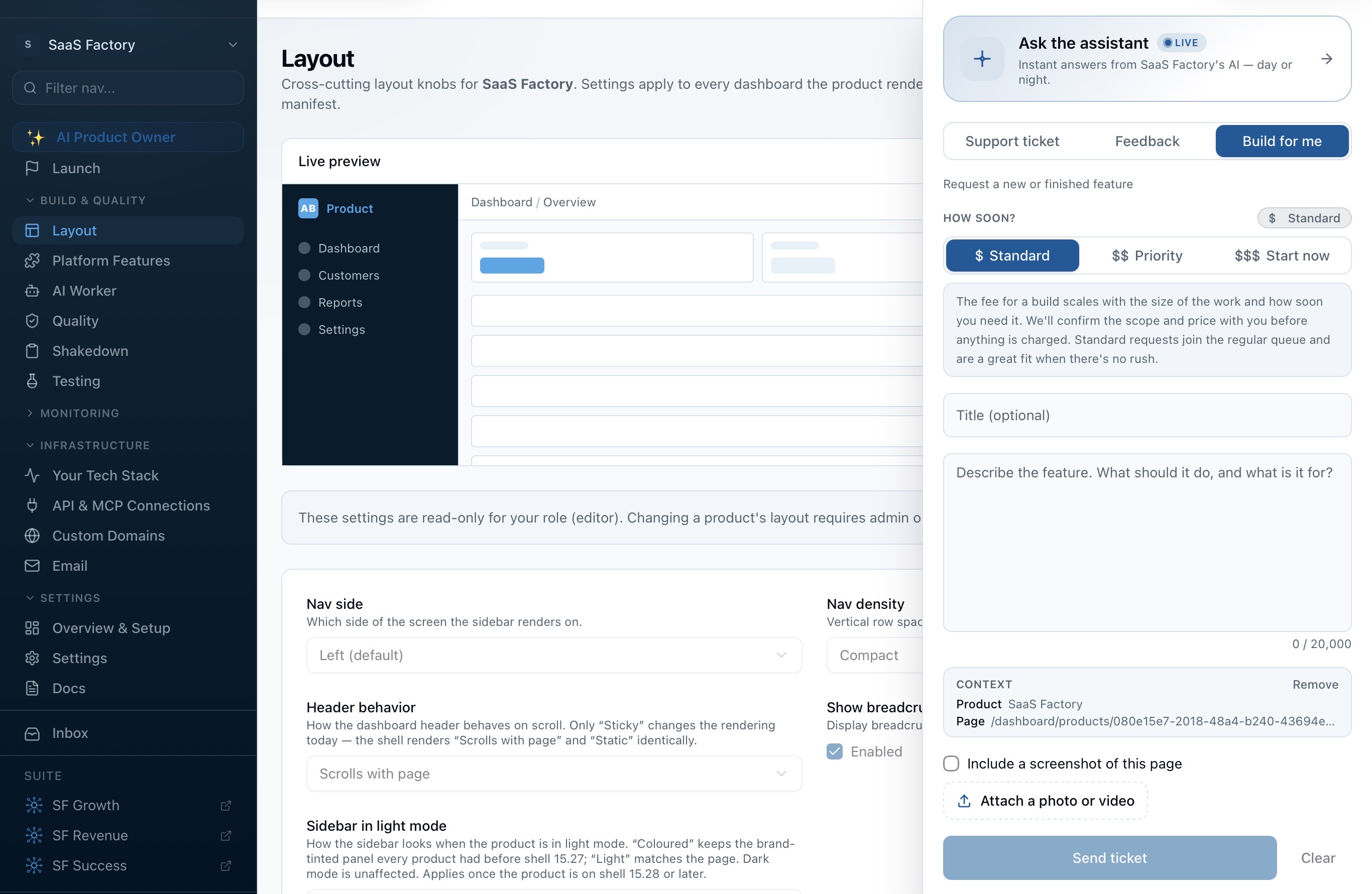
Stuck on a friction, the SF PO Agent, and if needed the CTO (the PO Agent will ask), steps in and clears it, with a fix or by building the feature that solves it.
Why it matters. No more black hole software requests. Customers see their words become working software the same day (in some cases the same hour), and they are told the moment it ships. That is how you keep customers paying and build defensible moats.
Side note. This one is so good we are re spinning it inside SF as a standalone product. That is exactly what the Respin feature in SF is for.
From the mission statement alone, the Growth Agent drafts your positioning, brand voice, ICP, competitor tracking and a do say and don’t say list. Then it makes you validate, asking for real interviews logged as evidence, Pain, Workaround and Mission Fit scored, and an overall Validation Score. Score low, and it challenges you.
“I ran it on SaaS Factory itself. It was 80 to 90% there and surfaced things I had not considered. Here’s the truth about startups, most build first, then go looking for the validation and market/vertical fit. That’s why so many fail. Normally only investors or scarred senior operators force this discipline on you, but in SF the agent does it from day one.”
Why it matters. Every feature must map back to the mission and every validation claim gets evidence behind it. If you are chasing investment, this is exactly the pack investors ask for, and it feeds the number that matters. Revenue Speed, not code speed.
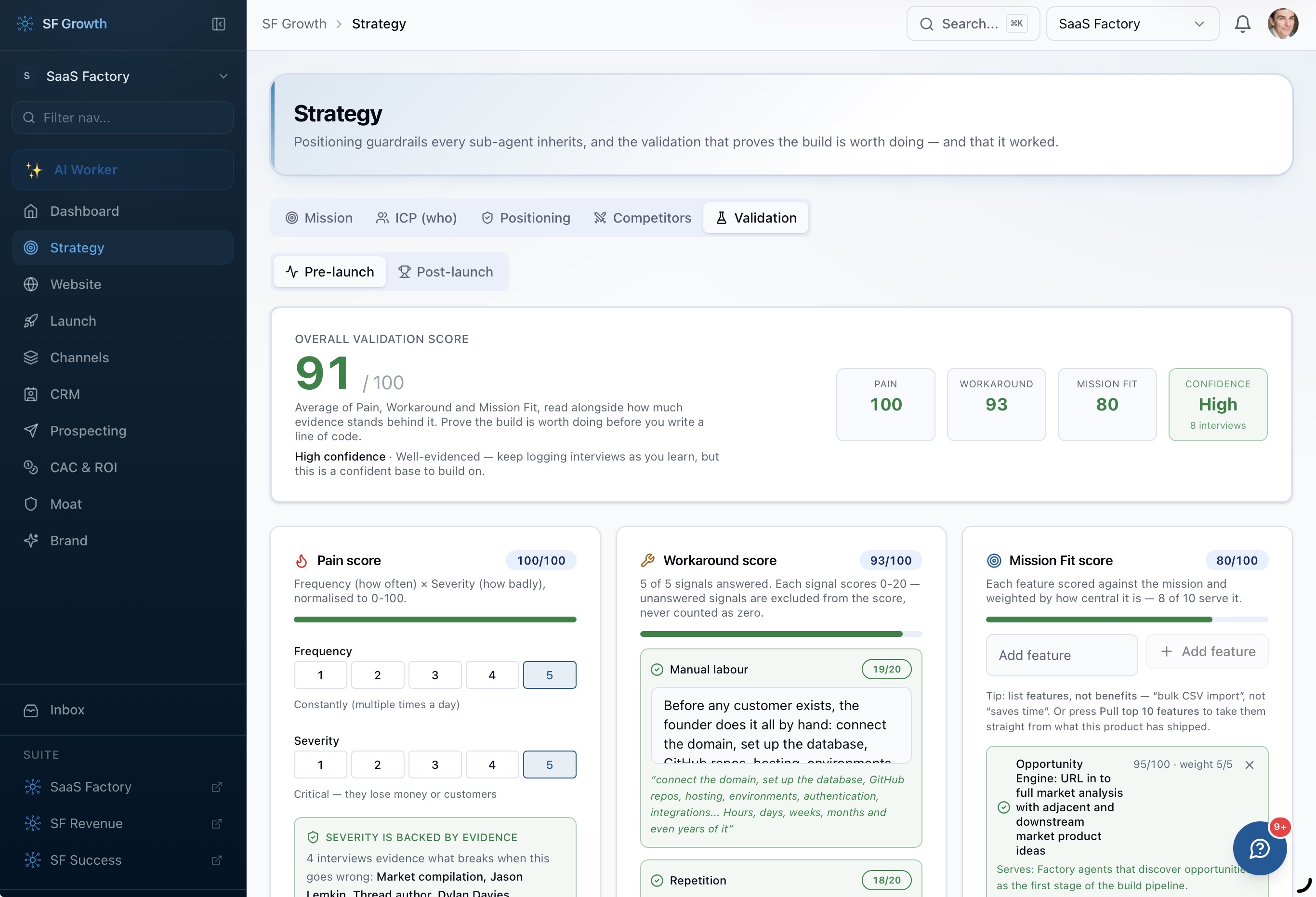
Validation Score with the three pillar scores, the Sean Ellis Test panel, and the do say and don’t say list.
The marketing site launches with the product, because the website IS the app. Same tech stack, not two platforms to manage and pay for. Pricing page wired from SF Revenue automatically and screenshots pulled from the product with content drawn from your mission statement, product features and growth strategy.
“AI gets the website content 90% there, and as a founder I still want my stamp on it, the human touch, but at least I’m not starting from a blank page. And my favourite section is Articles. Pages built specifically for AI to find and read, as that’s where your buyers’ AI look first.”
Why it matters. A separate marketing site is another platform, another cost, another thing drifting out of date. The SF website updates itself from the product and the strategy.
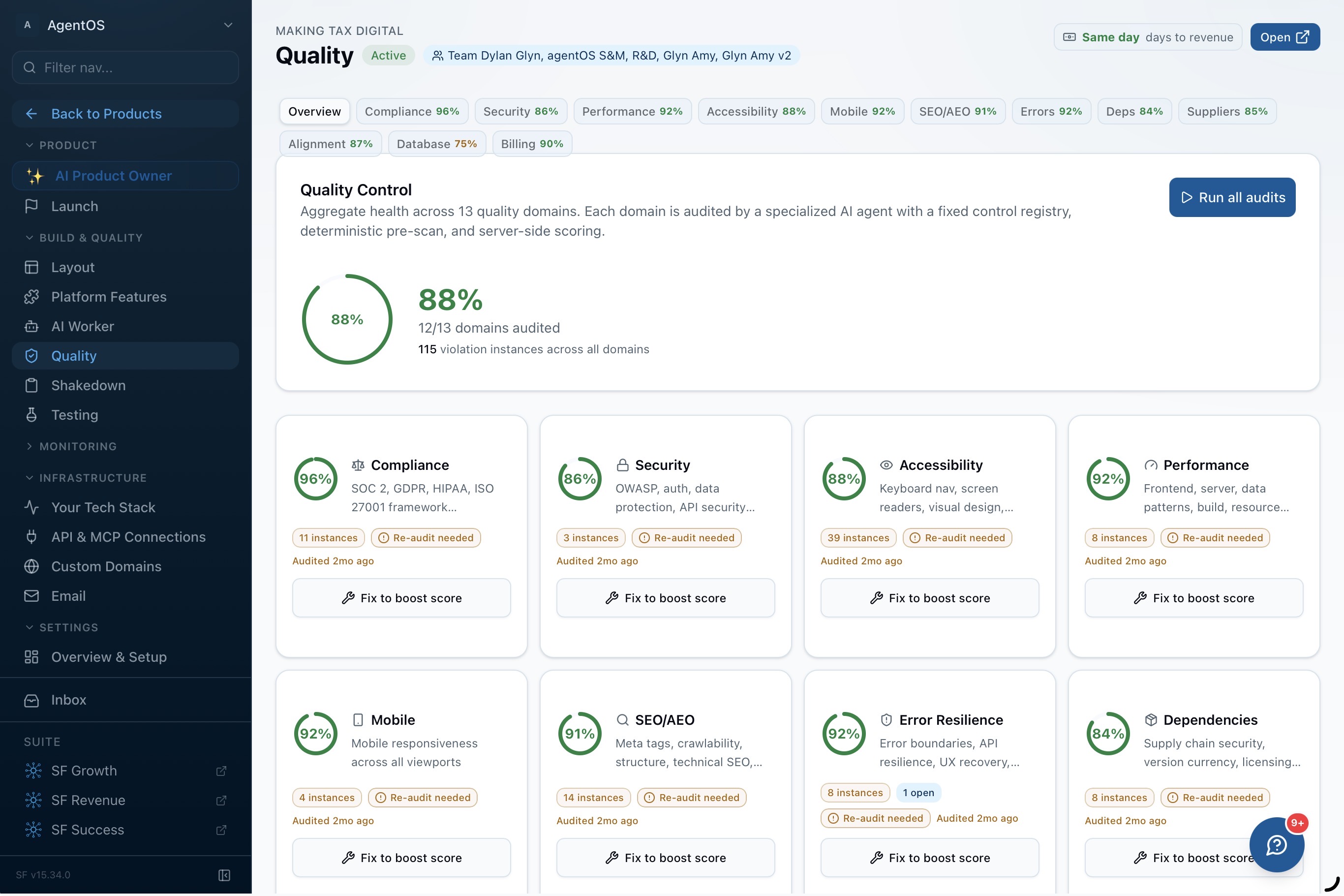
Every release is fully specced, auto tested including visual and AI user testing, audited and scored per release. All on autopilot.
“Honestly, this one didn’t excite me at first. At startup you patch quality as you go. Then the penny dropped as I sit inside Volaris, and to established businesses quality is not optional, it’s the buying decision. It even unlocked something new, public and private tenders. Take a tender from sites like tender.services.gov.ukor Proactis, feed it into SF to build out the MVP in days. Then submit a tender with a working MVP, all the tender requests and quality score reports attached, and the tender is already scoring high, door open. The other tenders are not turning up with a login to a product that’s scoring 100%.”
Dylan Davies, CTO: “Fast coding ships a product really fast, full of holes. Full specing, testing, quality, audits. A totally different ballgame.”
Why it matters. Enterprise buyers, procurement teams and tender panels do not buy holes. Quality scores turn AI built software into something an established business can sign off.
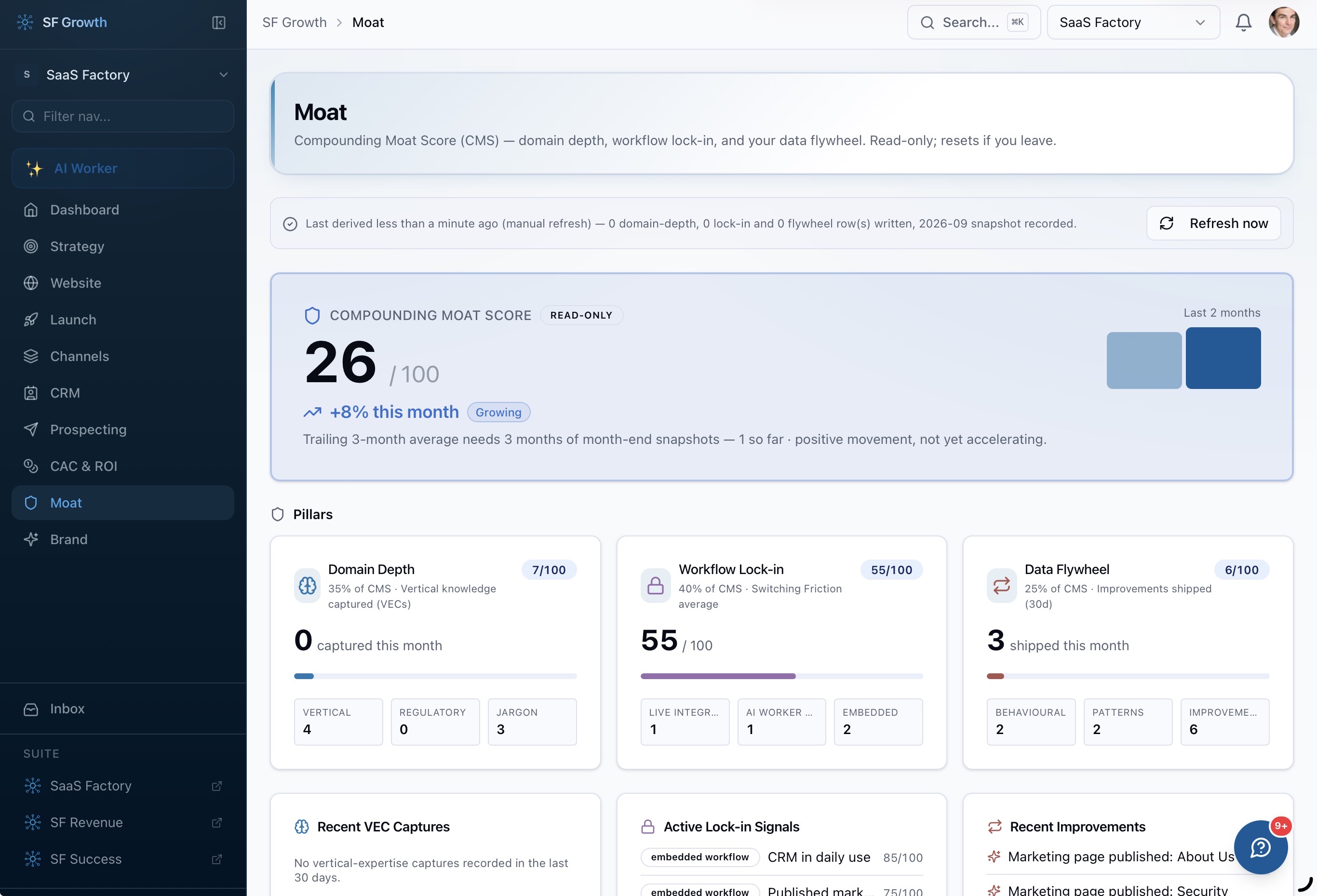
Three AI era moats, distilled from the classic ten using Anthropic’s Founder’s Playbook.
Agents score them as a Compounding Moat Score on a rolling 90 days, monitor them, and act to defend them on autopilot.
“Over the years moat conversations have been triggering panic. New to corporate life, I didn’t fully understand them. AgentOS had moats, I just hadn’t named them. Now with the AI SaaS threat, moats like Workflow Lock-in are about knowing how much the AI you provide your customer depends on. It’s about knowing your AI and workflows are being adopted and then becoming relied on. Then add Domain Depth, which usually lives in people’s heads and leaves when they do. And Data Flywheel, taking feedback and turning it into features, compounds your Moat score that only survives on a rolling 90 days, so the SF agents have to keep re earning it.”
Why it matters. AI can copy your product, but it is harder to copy what your moats know and do. And when you sell, this is the data at the negotiating table the acquirer needs to see live, defended and compounding, to gain confidence the business will keep growing after the deal. I know, I’ve sat on both sides of the table.
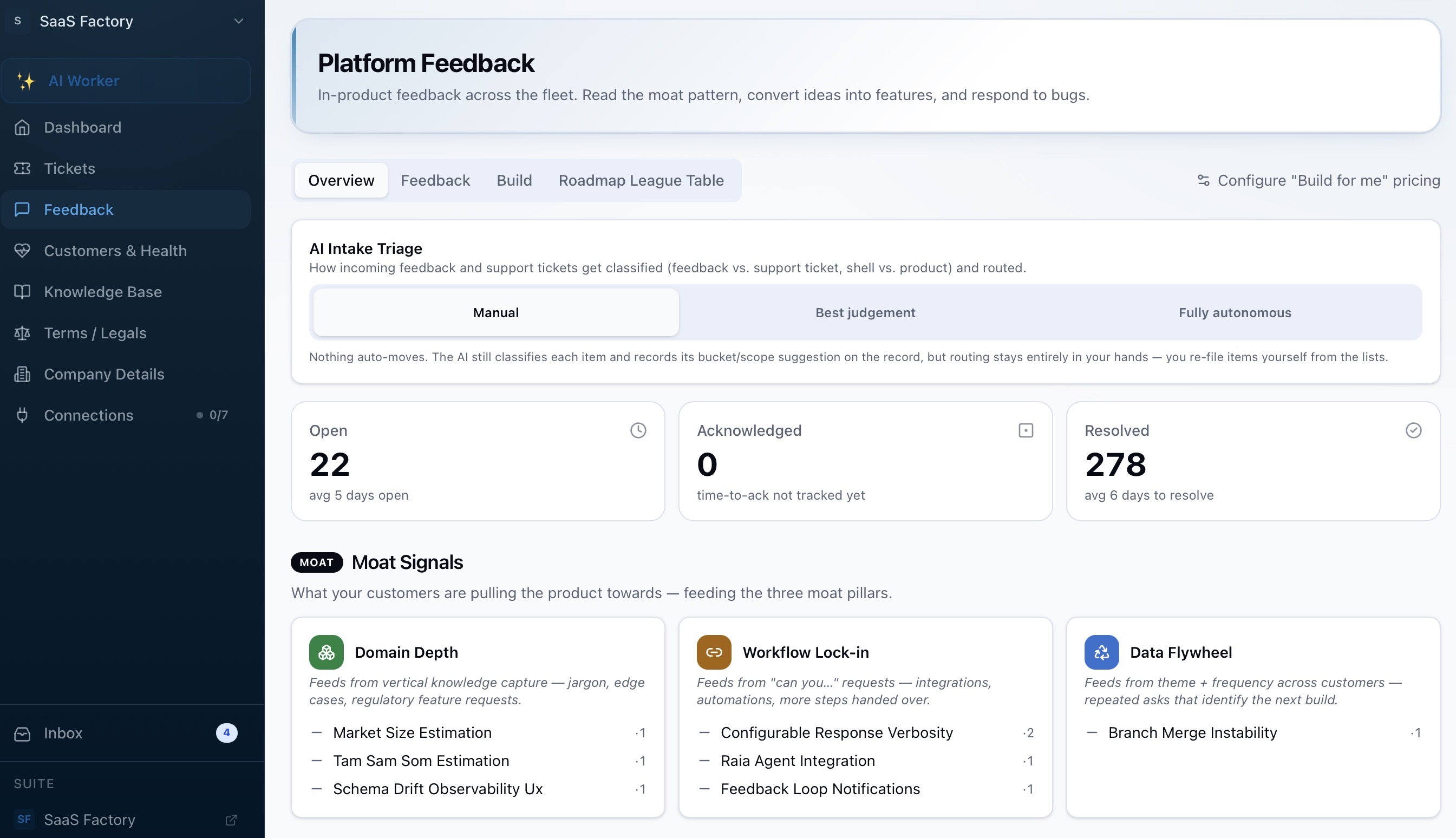
SaaS Factory has its own MCP server that can connect any AI agent directly to SF Core, SF Growth, SF Success and SF Revenue. It can read, direct, take action and run your products, the specs, the feedback, the releases, the whole business stack.
“The built in SF PO Agent is great to direct. But my real work lives in my Claude account; my connections, my memory, my skills, my chat, my projects, my artefacts. Opening the SF MCP connection joined the two worlds. From one chat I direct, run, discover and report across the 33 products I’ve built and am building in SF. My rule has always been, any system in my business that doesn’t have MCP gets replaced or built by SF. And this isn’t external AI connecting to vibe code, it’s connecting to the business stack, the CRM, the CSM, the moats, revenue.”
Why it matters. This is the new AI way of working, and it is happening everywhere. Every day I discover new capacity, access to new AI labs tooling and more importantly, new ways to grow and identify new revenue.
This is our critical number, and yours. From a customer creating an account, to deciding to subscribe to a paid service, and eventually their card actually being charged. Not the launch, not the free sign ups, but Paid Revenue.
“This exists because we Reverse Benchmarked the vibe coding tools platform. They’re brilliant at building, but they all measure apps built, not measuring the first £, €, $ or ¥ of revenue. An app can be built and hardened in under a day, that’s no longer the achievement. What matters starts when a prospect sees your product, likes it and commits money. And once the first revenue lands, you set the next revenue goal and chase that target.”
It is early days for SaaS Factory (Sept 2026). Our number is built on a couple of products generating revenue which we publish because it’s the one number that counts.
Glyn Trott founded agentOS in 2004 and sold it to Volaris in 2024. He continues to be CEO of agentOS Proptech Group, part of the Omegro and Volaris group, and co-founder of SaaS Factory. Glyn lives in Wales and is big into CrossFit.
These are my ten. The strange thing about these eyes light up moments is how fast they become normal. I use these features every day now and could never go back, and more just keep coming.